What Shapes Us

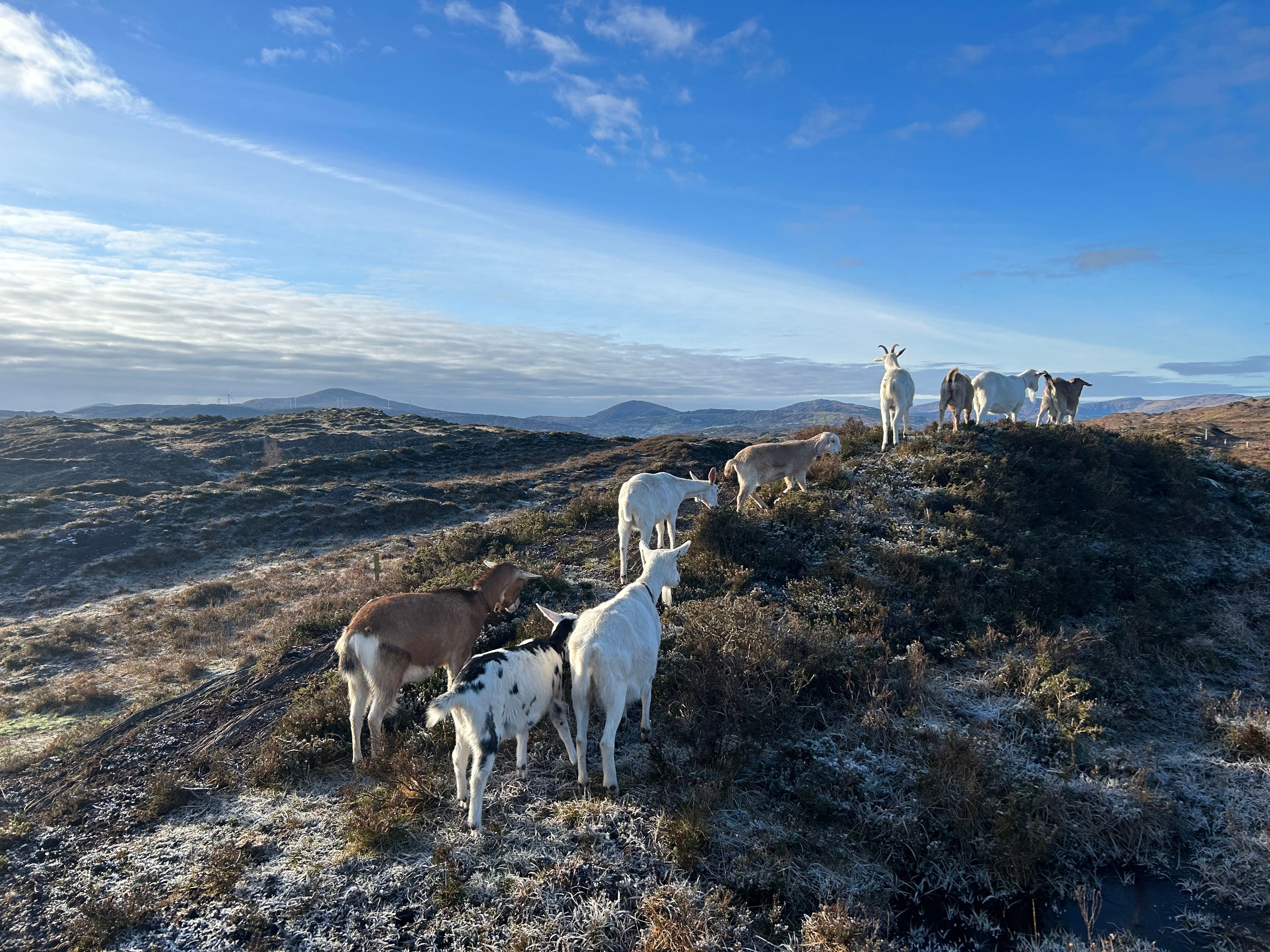
Our little farm sits on the edge of the Cork and Kerry Border Mountains, Cork side, but not too far from the Kerry border which runs along the mountain ridge. It is split between two small parcels of land just under three miles apart, at about 200 metres elevation. The highest peaks in the Cork and Kerry Border Mountains are 600 to 700 metres, so you could say we’re just less than a third of the way up. These hills are not high, but they are rugged, exposed, and wet.
Most of the land that makes up our farm lies on a steep, open ridge of heath, bog and rock, what we call the Hill, where my enduring husband and I spent two full cycles of the seasons living in a sixteen foot caravan that rattled and leaked—our Shepherd’s Hut—after we had sold our little cottage home and given most of our stuff away on a giant leap of faith, to start a new life in the hills. Those two years were probably the hardest of our lives, the two of us with two big dogs and a cat crammed up uncomfortably with only the barest necessities, no power or plumbing or any of the comforts or conveniences we’re all so dependent on, exposed to the brunt of the weather on the open Hill. And those years were also rich and beautiful and rewarding, in ways I struggle to describe. The experience stripped us to the bone, ground us down into pulp, and rebuilt us with grit and stone. It showed us what’s left when you strip away all the dramas and ego and superfluous stuff we all carry around, down to the core of what really matters. There just isn’t time for any of that when seeing to your most basic physical needs like water and shelter takes all the effort you’ve got. It reshaped our values and our goals and gave us a deep appreciation for the simple and most basic pleasures in life. We had already been farming that strip of wild, hill land for a few years before we came to live on it, running our sheep and goats over the heaths and rough pastures in summer, letting the land lie wet and dormant in winter. Nothing could have prepared us for living and farming on it so closely all year. It was there, by wood fire and candlelight in that rickety caravan that first winter on the Hill, where these stories began.
Now, we live in an old, tumbling down, stone farmstead that we are just beginning to slowly rebuild around ourselves, tucked into a wooded pocket in the hills down a forgotten little back lane that’s more pothole than road. Our farmstead sits within the Gaeltacht Múscraí, one of the last small pockets of Ireland where Irish Gaelic is still the primary language. One of the last strongholds of Irish culture against British rule. I have it from a living niece of the folk whose home this place was for many generations passed, that this old, stone farmstead once hid fugitives who fought against the British forces in Cogadh na Saoirse, Ireland’s War of Independence. I think it’s important to acknowledge the history of a place, the lives of the people who came before us, whose labour shaped the land we now farm and built this home we now call ours. The stories held in the stones. Not so long ago, this little old tumbledown farmstead was the big dairy farm of the area, the first around here to get a milking machine, no less, employing many folk who would walk from miles around to tend the cows and work the land. They milked the cows, and churned the cream into butter right here in the dairy room, back in the days before pasteurisation and the separation of food from source, when butter was hand-churned on-farm and pressed into sticks by the soap-scrubbed hands of farm kids. The dairy room now houses our freezers full of mutton and kid waiting to be simmered into winter stews, but I have half a mind to restore it to its former use.
We keep a small herd of dairy goats, mostly Nubian and Saanen, and a score of Shetland sheep who work the magic of transmuting heather and rough pastures, our thin, clay soils and heavy rainfall, into milk, meat and wool, and a little flock of laying ducks who turn mud and bugs into a year-round supply of sunny yolked eggs and the occasional feisty drake for the soup pot. The animals are the soul and sustenance of our farm and I write about all of it, from the blood of birth to the mud of death. Death is a big part of it. There is no escaping that, and I won’t brush over the profoundly life-changing reality of killing for our sustenance to make my stories more palatable. Hiding death away in the dark doesn’t make it any kinder. Knowing the animals we eat carries the weight of true gratitude for every morsel of sustenance and every precious beat of life.
We keep ducks rather than chickens for eggs for a number of reasons. There was a time, a decade or so ago on another farm, when we had hundreds of birds, poultry of all ilk. Ducks are by far the most characterful, entertaining and persistently cheerful of all farm birds, and I figure if we’re going to keep an animal then we’d better enjoy it. Liking the animals we’re labouring for helps a lot when the going gets tough and the fat of harvest thins through winter. Ducks are better layers than chickens. They lay steadily year-round without need for artificial light and they live long productive lives. We’ve known ducks to still give an egg a day at nine years old. But what really seals the deal for us is that ducks are supremely suited to our very wet, cool temperate climate. We get between 80 to 100 inches of rainfall per year in these hills (my rain gauge keeps on overfilling but there’s a handy rain station nearby that’s been tracking rainfall here since 1948, and it tells me these hills are, in fact, where most of Ireland’s rain falls). It doesn’t rain every day. At least not every day, every year. Our last few summers have seen soaring, azure skies that belong in the Mediterranean. But when it rains it rains hard enough to make up for all the days of drought. We’re talking monsoon rain. Rain that rips ravines into the roads and breaks boughs with its weight. On days when chickens and most sane people would be huddled up indoors cringing from the deafening deluge hammering on the roof, our farm ducks are out there splashing jubilantly in the downpour. “It’s lovely weather for ducks!” gets said quite a lot around here.
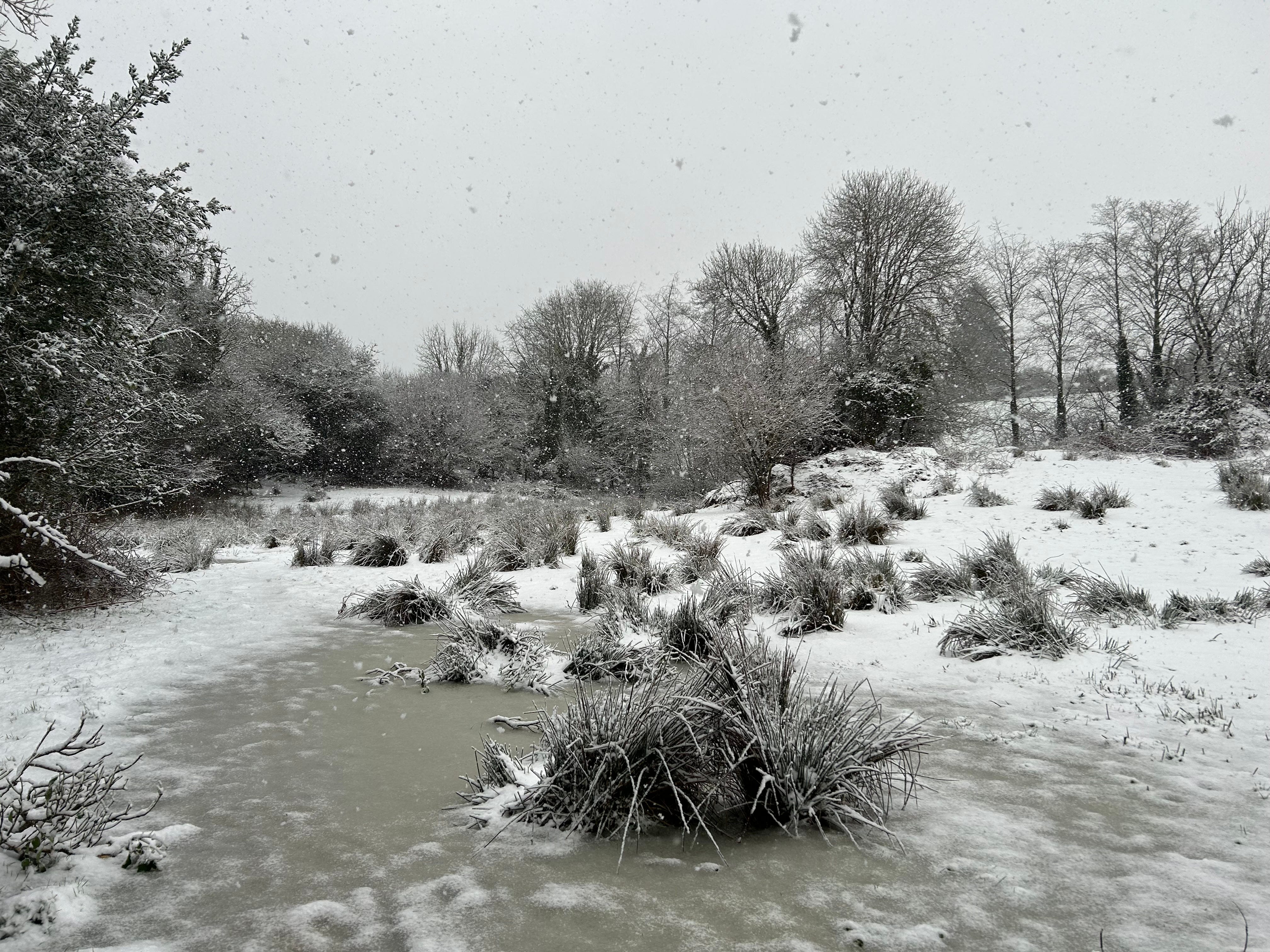
In winter, our lowest fields are under water, and our Hill is a wetland of flooded bogs, wet heaths and waterfalls. Besides a few hardy hill sheep of the Scotch type that thrive on heather and rain dotted across the hills, hoofed animals are generally housed through winter in this part of the world to save the soil from poaching. There is no grass growth in winter, hay must be fed, and it’s usually better fed on dry standing indoors because there won’t be any grass growth in spring either if the fields are churned to mud by heavy hooves in winter. Our sheep and our goats are all snug in their barns with their feeders and their bellies full of sweet summer hay and it is snowing outside as I write, in big, wet dollops that melt as soon as they touch the ground, turning the mud to slush.
I wrote last time about how work on the farm intensifies in winter to the drudging grind of keeping animals fed and dry, squeezed into short, hard days of heavy labour. January shows us where we need to pare back, to reduce, to cut the load. What we need to cull. But there’s a stillness to the routine at this time, too, in these days between years when the sun stands still and the stillness is felt like silence, like a quiet interlude between the busyness of normal life. There is no hurry. No pressure. No noise. One year is done, and what didn’t get done doesn’t matter now. The new year doesn’t really begin until the frogs start to spawn in a few weeks yet and the goats’ bellies swell with kid.
I confess, I do start my January mornings cosied up by the fireside drinking homemade raw milk latte (minus the cinnamon). Yesterday’s milk courtesy of our most generous little house goat, Glitter Sparkle, the one goat I’m keeping milking through winter, heated gently on the stovetop. A shot of strong, black coffee. A spoonful of summer clover honey from the beekeeper in the valley. If it weren’t for these simple pleasures then what would be the point in it all? Why else would we tie ourselves to the year-round, seven-day rhythm of milking and the labour the farm demands? “It’s a labour of love” an older farmer said to me, recently. But I think the reward is in how the effort we put into building our lives shapes us and the little pocket of the world we live in.
Your farm is something I used to dream about in my younger days but I don’t think I would have had the stamina for it. I love reading your posts though and living vicariously through your trials and your pleasures 💖 sending love and good wishes for another year. I do hope you can get your house more habitable this year. I did live in a house that was being worked on for most of my married life so I do know what that is like 🤣🥰
Wonderful post! I was born on a farm in Hungary (called a tanya in Hungarian) in 2010, and we moved away from there when I was 4 years old. Then we lived in Scotland and in England for awhile, finally ending up in Romania, where we've been living for the past 9 years. It is a fantastic place to live!!! 💖 I feel that all the places I have lived in have shaped me in some way... And I am eternally thankful for all the memories I made in each place I have lived, but especially I am thankful for my current home, nestled in the mountains of Romania, close to the Ukrainian border.